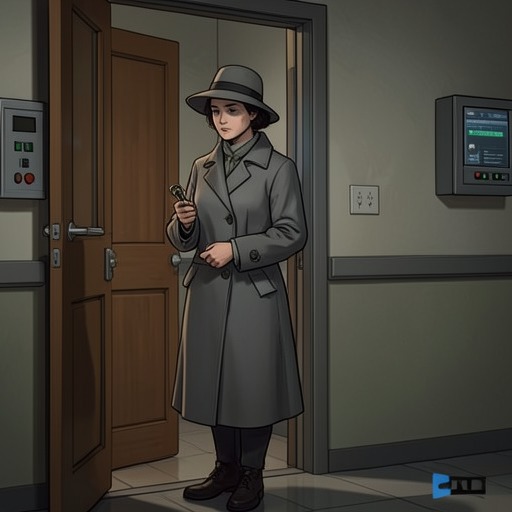
Carolo Bocanegra
Los renglones torcidos de DiosCarolo Bocanegra is an asylum patient whose apparent mutism is exposed as a deliberate refusal to speak, while a later roster also identifies him as voluntarily blind. He first enters Alice Gould’s investigation not through speech but through a pocket notebook: a means of communication that both sustains his silence and reveals that it is chosen. The same object bears colored notes that prompt Alice to place him among the possible authors of criminal letters addressed to her client, Raimundo García del Olmo. The narrative gives him an arresting contradiction, but does not establish that suspicion as fact.
Identity and First Encounter
Carolo is seated at the last table in the refectory, in a corner Alice later learns was not chosen by chance. His table companions include a quiet young woman and Ignacio Urquieta, who protests when Alice is about to sit down. Urquieta explains the social arrangement around the table: the young woman speaks little, while Carolo is considered a mute. The introduction thus makes Carolo known first through other people’s descriptions, before he communicates for himself.
When Alice asks whether he is unable to speak, Carolo takes a small oilcloth notebook from his pocket and writes with an orange marker. His answer makes the distinction plain: he can speak, but does not want to. The moment unsettles the category applied to him. Carolo has not been unable to answer; he has chosen a different way of controlling when and how he responds. Alice notices the mismatch but restrains the laughter and comment that occur to her.
The Notebook and Alice’s Suspicion
The notebook is more than a substitute for speech. Alice observes that its pages are covered with notes in different colors, details she keeps in mind even amid the many other impressions competing for her attention. She gives Carolo the nickname the False Mute and adds him to an initial list of suspects in her inquiry into the criminal letters sent to Raimundo García del Olmo.
That suspicion is an investigative lead, not a disclosed solution. The evidence connects Carolo to the letters through Alice’s reading of the notebook’s colored marks; it does not confirm that he wrote them. The object therefore holds two kinds of uncertainty at once: it proves that his silence is voluntary, while its unexplained notes invite Alice to infer a further secret. Carolo’s chosen quiet makes him difficult to read, but it does not itself establish guilt.
Conflict and the Limits of What Is Known
A later passage raises the possibility that Alice answered Carolo insolently on another occasion, including by calling him a well of stupidity. The phrasing presents this as a question about her behavior rather than a fully settled account of a confrontation. It suggests that Carolo’s performed silence could become a point of irritation in the asylum’s social life, but gives no detailed exchange, response from Carolo, or consequence that would justify treating the incident as a major conflict between them.
The narrative likewise supplies no explanation for Carolo’s voluntary blindness. A later list of asylum figures identifies him as both a false mute and voluntarily blind, extending the pattern of deliberate concealment beyond speech. It does not describe how he acts as a blind man or explain what purpose the pretense serves. Those limits matter: the labels establish the deception, but not its full history or motive.
Narrative Role
Carolo’s brief appearances make the gap between an observed condition and an assumed incapacity visible. At first, the other patients’ designation of him as mute seems to settle what he can do; his notebook revises that impression in a single stroke. Alice’s investigation then turns the notebook from a means of communication into potentially incriminating evidence, without resolving the inference she draws from it. Carolo remains both legible and opaque: he openly discloses that he could speak, yet withholds speech, and the notes that attract suspicion are not explained. His later identification as voluntarily blind sharpens this portrait of a patient whose apparent limitations cannot safely be read as simple inability.